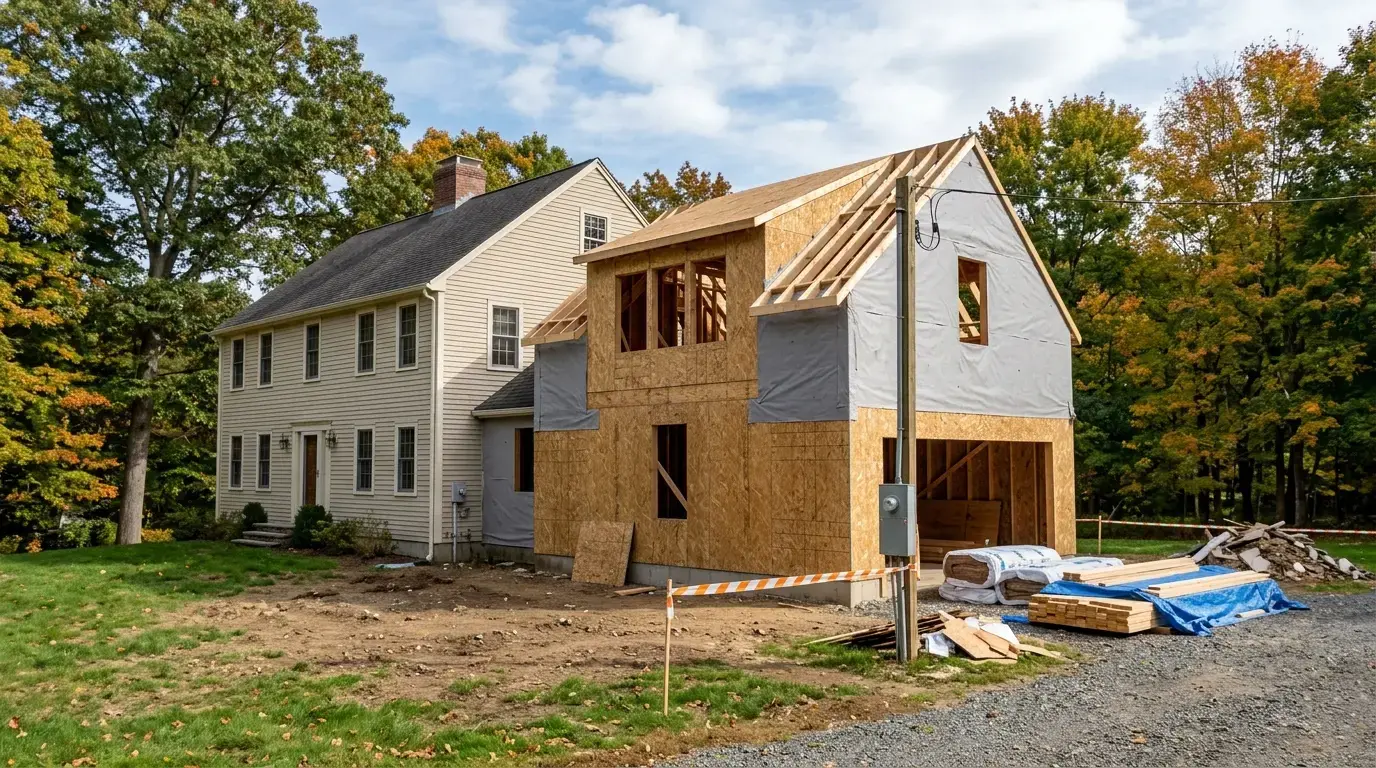
Home Addition or Move? How to Decide in Connecticut
When your family outgrows its house, it comes down to one big choice: add on or move. Weighing a home addition versus moving in Connecticut is not just about square footage.
Category · Decision Guide
7 min read
Central CT
When your family outgrows its house, it comes down to one big choice: add on or move. Weighing a home addition versus moving in Connecticut is not just about square footage, it is about money, location, disruption, and how much you like where you already live. Both paths can get you the space you need, but they lead to very different outcomes. Moving means buying, selling, and starting over somewhere new, along with all the costs that come with it. An addition means staying put and building the space into the home you already have.
01 · The Real Question
Space or Location?
Before you compare prices, figure out what you are actually trying to solve. If your home works but you just need more room, an addition keeps everything you already like and adds the space. If the problem is the location, the lot, the commute, or the neighborhood, no addition fixes that, and moving is worth a serious look.
In Connecticut, where towns, schools, and shoreline access vary a lot from one place to the next, location often carries real weight. Families who love their street, their schools, and their neighbors usually lean toward adding on. Those who feel stuck in the wrong spot lean toward moving. Getting honest about this question first makes the rest of the decision much clearer.
02 · Addition Wins
When a Home Addition Wins
An addition tends to win when you like where you live and want to stay. If your neighborhood, schools, and commute already work, building the extra space into your home lets you keep all of that. Additions also avoid the heavy transaction costs of moving, like agent commissions, closing costs, and the price gap to a bigger house in a market you like.
You get exactly the space you want, designed around how your family lives, instead of settling for someone else's layout. In Connecticut's established towns, where the homes you would move to may be just as old, adding modern, code-built space to a house you already love is often the better value. Home additions also skip the stress of selling and relocating.
Compare real numbers, not gut feelings
The right way to decide between an addition and moving is with a written addition estimate on one side and the true all-in cost of moving on the other. Once both figures are on paper, the choice usually gets clear.
03 · Moving Wins
When Moving Makes More Sense
Moving can be the smarter choice when your needs go beyond what an addition can solve. If your lot is too small or steep to build on, if zoning and setbacks limit what you can add, or if you need a fundamentally different home, buying may be the cleaner path.
Moving also makes sense when location itself is the issue, or when you would have to add so much that you would over-improve for the neighborhood. It is worth remembering that a home should fit its street, and pouring a huge addition into a modest block does not always pay off at resale. If the house or the location has hit a wall, a move gives you a fresh start that even new construction on the same lot might not.
04 · How to Decide
Cost, Disruption, and How to Decide
Both options cost money and both create disruption, just in different ways. Moving spreads costs over the sale, the purchase, and the move itself, and it uproots your routine. An addition is a construction project, so you live through the build, but you stay in place and end up with new, code-built space and often more home value.
The right way to decide is to get real numbers. Have a contractor look at your home and lot and give you a written estimate for the addition, then compare that against the true, all-in cost of moving to a house that meets your needs. Once you can see both figures side by side, the choice usually gets a lot clearer. Request your free estimate and compare.
FAQ
Frequently Asked Questions
It often is, once you factor in commissions, closing costs, and the price jump to a bigger house. The only way to know for sure is to compare real numbers for both.
In many cases, yes, if the existing structure and foundation can support it. We will evaluate your home and tell you honestly what is possible before you commit.
A well-built, code-compliant addition usually adds value, as long as it fits the neighborhood. Over-improving for the block is where the return starts to drop off.
There is noise and activity, but we seal off the work area so you can keep living in your home. It is a project, but a well-run one stays manageable.
Start with whether the problem is space or location, then compare a written addition estimate against the full cost of moving. Real numbers make the decision clear.